
The Memory Bill
The AI architecture debate is a fight over where a model keeps what it knows, and who pays for it.

When an AI model knows something, where does that knowledge sit, and who pays to keep it there?
The industry has several places to put memory. Knowledge can live in the context window, a compressed internal state, a learned model of the world, an external checker, a persistent state that never fully switches off, or the data center itself. Each option solves a different technical problem, carries a different failure mode, and sends the bill to a different part of the system.
This debate is usually filed under “beyond the transformer.” The more useful question is where memory should live and what each location costs.
Memory as rent
Since 2017, most major language models, including ChatGPT, have relied on the transformer. Attention compares each new token with the material already in the context window, which becomes the model’s working memory at inference time. Longer context requires more state to be stored and consulted as each token is produced. That capability is powerful and expensive. Transformers effectively rent memory by the word on every run. For most of the past decade, the industry responded by renting more through larger datasets, more chips, and greater spending. That worked until the inexpensive gains began to run out.
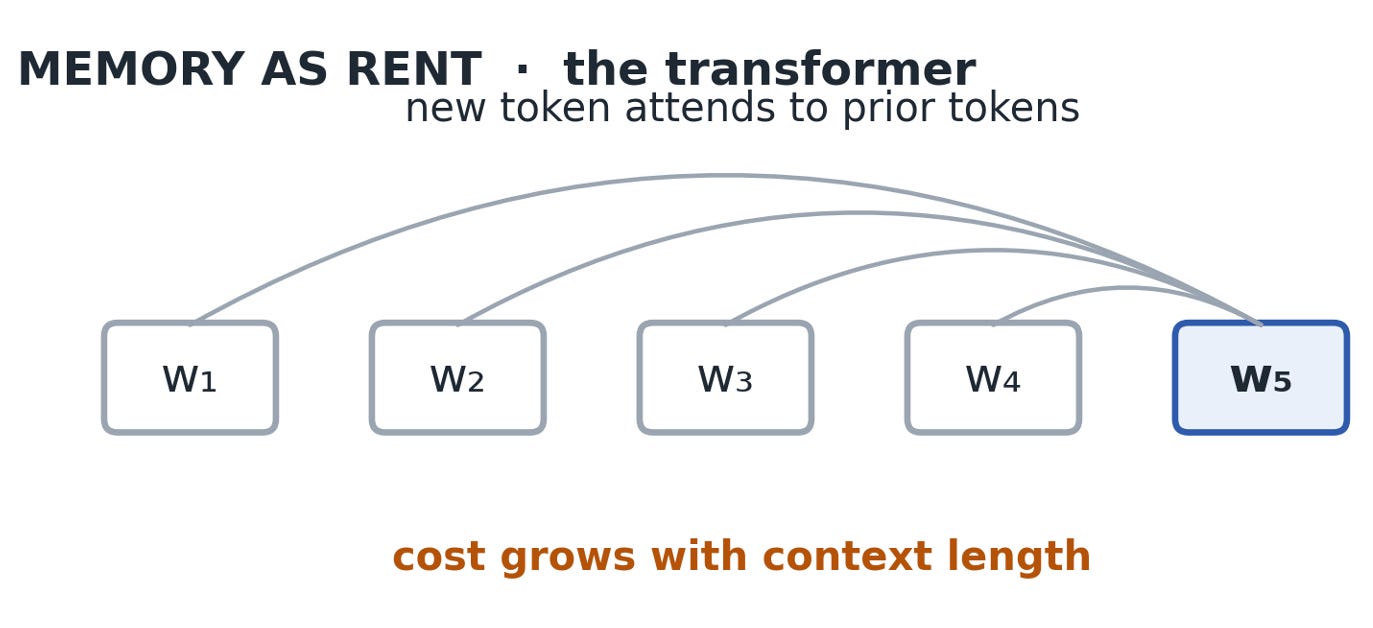
How a transformer attends to every earlier word. Based on Vaswani et al., “Attention Is All You Need” (2017).
Memory as compression
State-space models offer another route. Systems such as Mamba fold the past into a compact internal state that is much cheaper to carry across long inputs than a full attention map. Compression sacrifices precision, especially when a user asks the model to recover or quote an exact earlier line. The trade works best for builders who value inexpensive processing across very long inputs more than perfect recall of every detail.
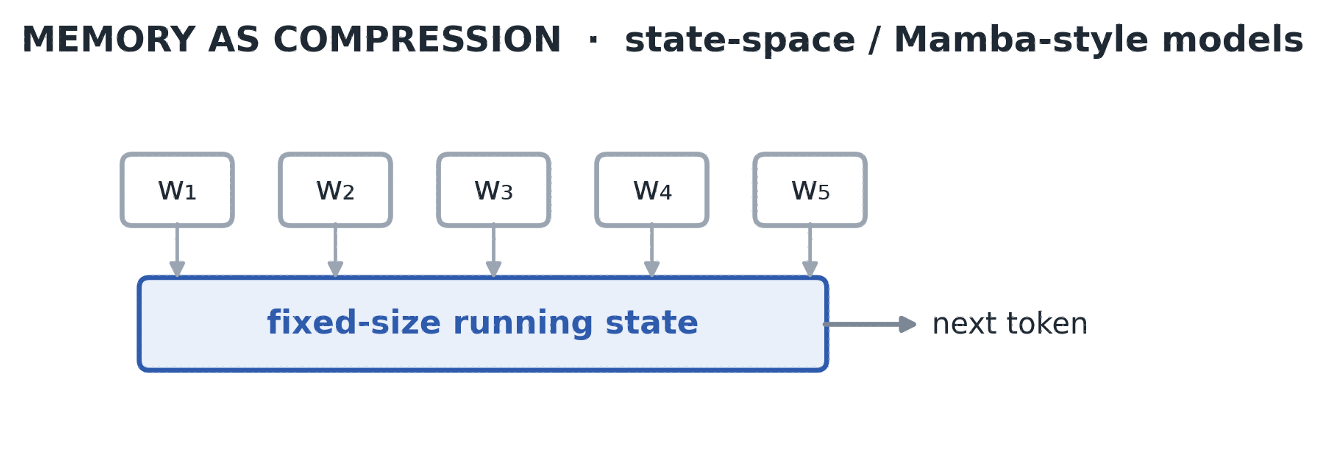
The past folded into a fixed-size state. After Gu & Dao, “Mamba” (2023).
Memory as understanding
World-model advocates question whether the transcript is the right object to preserve. The approach behind Yann LeCun’s new Paris lab, which raised more than $1 billion after he left Meta, tries to store how the world behaves instead of everything said about it. A system that understands cause and effect, such as why a dropped glass breaks, may need less brute-force memory than one reconstructing experience from text. The bet is aimed primarily at robots and other machines operating in the physical world.
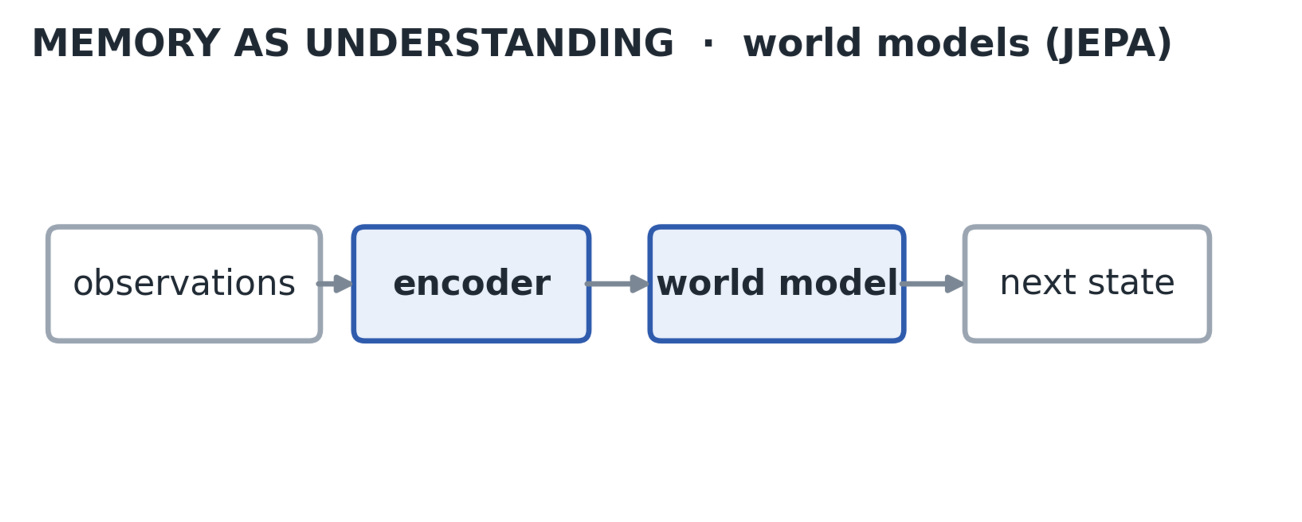
Prediction in representation space, not in words. After LeCun’s JEPA work, AMI Labs.
Memory as verification
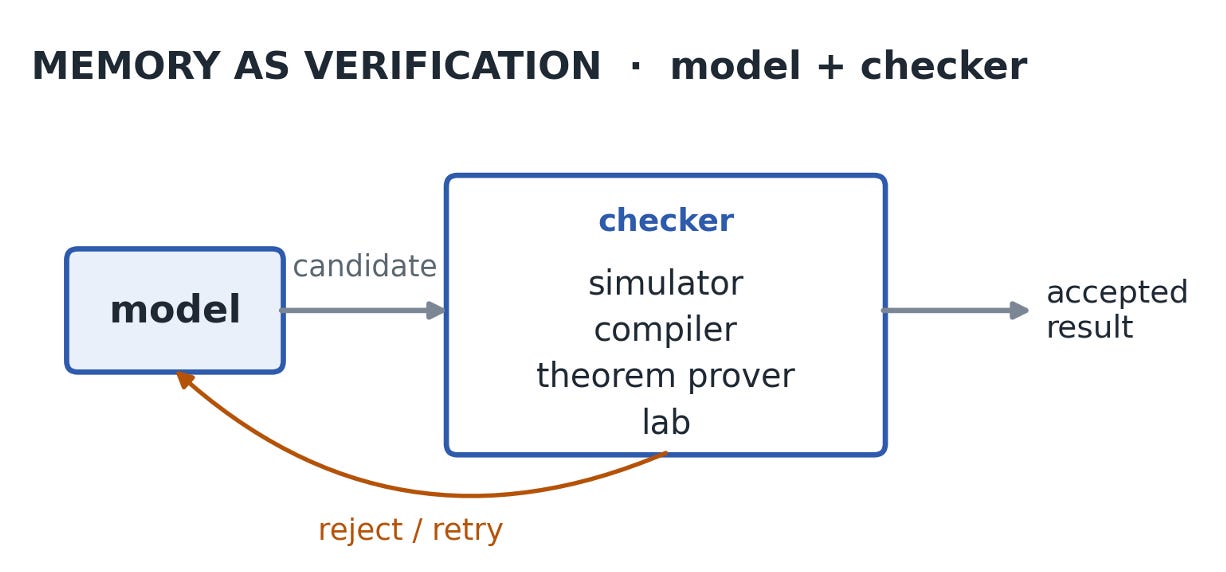
Verification pushes memory outside the model. The system stores a way to test an answer instead of storing the answer itself. Much of the most convincing AI discovery work follows this pattern: a model proposes, while something stricter judges. The judge may be a simulator, compiler, theorem prover, or laboratory experiment. Correctness lives in that external system, which keeps only the proposals that pass. The expense remains, only now it appears as the cost of verification.
Memory as continuity
Brain-inspired systems begin with the idea that intelligence should carry state across prompts. A brain does not reread its entire life whenever it forms a thought; its internal state reflects both recent events and older experience. Neuromorphic approaches seek a persistent state that keeps updating instead of rebuilding the past from scratch. The analogy is useful up to a point. Biology can suggest engineering directions, but it is not a product roadmap.
Memory as real estate
Hyperscalers can answer the memory question by owning the building. They can spend more on memory while also engineering it to cost less. When Nvidia ships a hybrid that replaces many expensive attention layers with cheaper Mamba-style layers while keeping accuracy roughly steady, it is absorbing a new architecture into the economics of the old one. A company that owns the data center can rent memory cheaply to itself.
Owning the building means amortizing the bill, not escaping it. Example: Nvidia’s Nemotron hybrids.
Architecture therefore becomes an economic decision, and no lab starts with a blank sheet. The choice reflects the compute fleet it already owns, its available memory bandwidth, latency targets, customer workloads, and desired margins. Choosing an architecture is partly choosing where the company wants to pay for intelligence; the balance sheet determines more of the design than researchers usually admit. Bets on compression, world models, or new substrates often come from players that cannot win a pure spending contest. For them, cheaper memory is a condition of competing. Incumbents can remain eclectic because they can fund several approaches and absorb the best ideas into their existing stacks.
The likely outcome is incremental. New architectures rarely displace an incumbent in one move. The incumbent usually borrows the useful pieces and reduces its weaknesses until the challenger’s central idea appears inside the next version of the established design. Transformers may survive by becoming less pure, adding compression, memory caches, and other mechanisms until “beyond the transformer” also describes the transformer.
Over the next two years, the key question is whether hybrids deliver durable, low-cost memory before the more radical alternatives have their opening. If they do, transformer skeptics may prove correct about the science while misjudging who captures the economics.
The same labs continue to ship larger models and papers on storing memory more cheaply. Memory has a cost structure, and architecture determines where that cost lands.